


Measuring Motion: The Critical Role of Automotive Displacement Sensors in Modern Vehicles
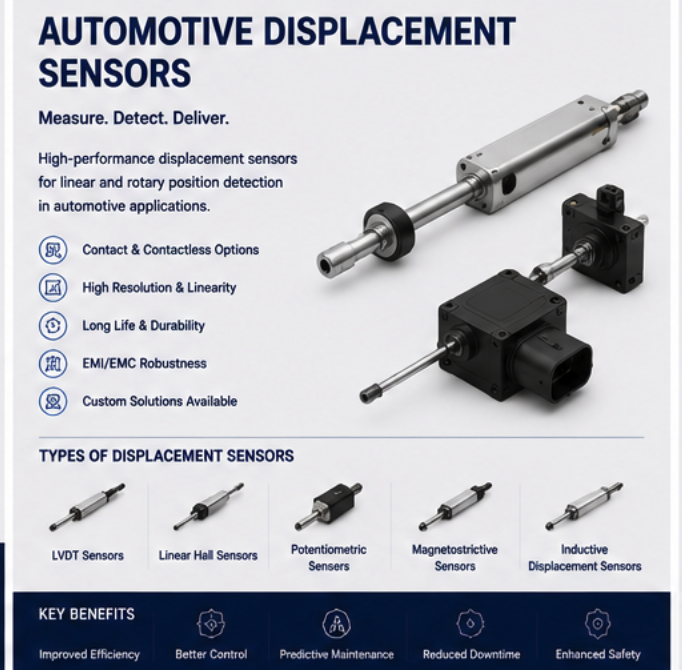
Every movement within a vehicle—a pedal pressed, a valve opened, a wheel turned—contains information. Capturing that information is the job of Automotive Displacement Sensors. These devices measure the distance or angle a component has moved, converting mechanical motion into electrical signals that vehicle computers can understand. They are the essential interface between the physical world and the digital brains of modern cars. Among the most critical of these devices are Electronic Throttle Position Sensors, which directly control engine power output based on driver demand.
What Is Displacement Measurement?
Displacement is simply a change in position. Automotive displacement sensors measure:
-
Linear displacement: Movement along a straight line (e.g., a pedal moving 50 mm from rest to full travel).
-
Angular displacement: Rotation around an axis (e.g., a throttle plate rotating 90 degrees from closed to open).
The sensor output is typically a voltage, current, or digital value proportional to displacement. A throttle position sensor might output 0.5 volts at closed throttle and 4.5 volts at wide-open throttle.
Why Displacement Sensors Are Everywhere
Automotive Displacement Sensors are used in virtually every vehicle subsystem:
Powertrain:
-
Throttle position sensor (TPS): Measures accelerator pedal position and throttle plate angle. The engine computer uses this to determine fuel delivery, ignition timing, and transmission shift points.
-
Camshaft and crankshaft position sensors: Measure the angular position of engine rotating parts, enabling precise fuel injection and spark timing.
-
EGR valve position sensor: Ensures exhaust gas recirculation valve opens to the correct amount for emissions control.
-
Turbocharger vane position sensor: Controls boost pressure in variable-geometry turbochargers.
Chassis:
-
Steering angle sensor: Measures how far and how fast the driver turns the steering wheel. Used by stability control, lane keeping, and parking assist.
-
Brake pedal position sensor: Measures driver braking intent. Used by brake-by-wire systems, regenerative braking, and brake light activation.
-
Suspension height sensors: Measure ride height for active suspension, headlight leveling, and load-leveling systems.
-
Gear shift position sensor: Detects which gear the driver has selected (PRNDL).
Body and Comfort:
-
Seat position sensors: Memory seats use position sensors to return to the driver's preferred setting.
-
Window position sensors: Detect when a window is fully closed (for pinch protection).
-
Sunroof position sensors: Track sunroof position for automatic closing.
Electronic Throttle Position Sensors: The Critical Component
Electronic Throttle Position Sensors are arguably the most important displacement sensors in a vehicle. In a drive-by-wire system, there is no mechanical connection between the accelerator pedal and the engine throttle. Instead:
-
Pedal position sensor (APS) measures how far the driver presses the pedal.
-
The engine computer interprets this as a torque demand.
-
The computer commands a throttle actuator to open the throttle plate to the calculated angle.
-
Throttle plate position sensor (TPS) confirms the plate has reached the commanded position.
Redundancy Is Required:
Because unintended acceleration is a safety hazard, electronic throttle systems use redundant sensors. Typical designs include:
-
Dual track potentiometers: Two separate resistive tracks on the same sensor.
-
Two independent sensors: One magnetoresistive, one Hall effect.
The computer compares the two readings. If they disagree beyond a tolerance, the system defaults to reduced power (limp mode).
Sensors for Electric Vehicles
While Electronic Throttle Position Sensors remain important, EVs have unique displacement sensing needs:
-
Accelerator pedal sensor: Same as conventional vehicles—the driver demands torque.
-
Brake pedal sensor: Must distinguish between driver braking and regenerative braking. Often uses dual sensors for redundancy.
-
Decoupling sensor: Detects when the brake pedal is pressed enough to engage the friction brakes (after regen maxes out).
-
Park lock sensor: Confirms the transmission park pawl is engaged.
-
Charge port door sensor: Detects if the charge port door is open.
The Technology Behind Displacement Sensing
Different applications require different sensing technologies:
| Technology | Best For | Typical Accuracy | Cost |
|---|---|---|---|
| Potentiometer (contact) | Low-precision, low-cost | ±1% | Low |
| Hall effect (magnetic) | Non-contact, durable | ±0.5% | Medium |
| Magneto-resistive | High-precision magnetic | ±0.1% | Medium-High |
| Inductive (LVDT) | Extreme precision, harsh environments | ±0.01% | High |
| Optical | Very high resolution | ±0.01% | High |
Potentiometers (contact-based) are the oldest technology. A wiper slides along a resistive strip. They are inexpensive but wear over time. Used in older vehicles or non-critical applications.
Magnetic sensors (Hall effect, magnetoresistive) are non-contact. A magnet moves relative to the sensor. They are durable and accurate, making them the modern standard.
Inductive sensors (LVDT) are extremely robust, operating in high temperatures and dirty environments. Used for suspension height and other harsh applications.
The Challenge of Harsh Environments
Automotive displacement sensors face extreme conditions:
-
Temperature: -40°C to +150°C (-40°F to +300°F) underhood.
-
Vibration: Sustained vibration and shock from rough roads.
-
Contamination: Oil, water, dirt, salt, brake fluid.
-
Electromagnetic interference (EMI): From alternators, ignition systems, and electric motors.
Sensor designs must be sealed (IP67 or IP69K for underhood), ruggedized, and immune to EMI.
Sensor Diagnostics and Failures
Modern Automotive Displacement Sensors include diagnostic features:
-
Out-of-range detection: The sensor reports if the measured position is impossibly high or low.
-
Signal plausibility: The computer checks if the sensor reading makes sense given other data (e.g., throttle position vs. engine airflow).
-
Redundancy check: Dual sensors are compared.
Common failure symptoms:
-
Throttle position sensor failure: Poor acceleration, rough idle, check engine light.
-
Brake pedal sensor failure: Brake lights stuck on or off, reduced braking assist.
-
Steering angle sensor failure: ESC warning light, poor lane keeping performance.
The Future of Displacement Sensing
The Electronic Throttle Position Sensors market continues to evolve:
-
Integration: Sensors integrated into control modules, eliminating separate housings and connectors.
-
Wireless sensors: For rotating components (steering wheel, wheels), eliminating slip rings and rotary connectors.
-
Predictive maintenance: Sensors that track their own wear and alert the driver before failure.
-
Fully digital interfaces: Sensors that output data directly on the CAN bus or Ethernet.
Conclusion
Every push of a pedal, turn of a wheel, or press of a button creates motion—and Automotive Displacement Sensors measure that motion. From engine management to safety systems, these sensors are indispensable. Electronic Throttle Position Sensors ensure that the engine delivers exactly the power the driver requests. As vehicles become more automated and electrified, the demand for accurate, reliable displacement sensors will only grow. Measuring motion is measuring control.
 Greek
Greek
 English
 Arabic
 French
 Spanish
 Portuguese
 Deutsch
 Turkish
 Dutch
Dutch
 Italiano
 Russian
 Romaian
 Portuguese (Brazil)
