


The Complete Cognitive Services Framework: NLP, Vision, Speech, Analytics, and APIs for Digital Success
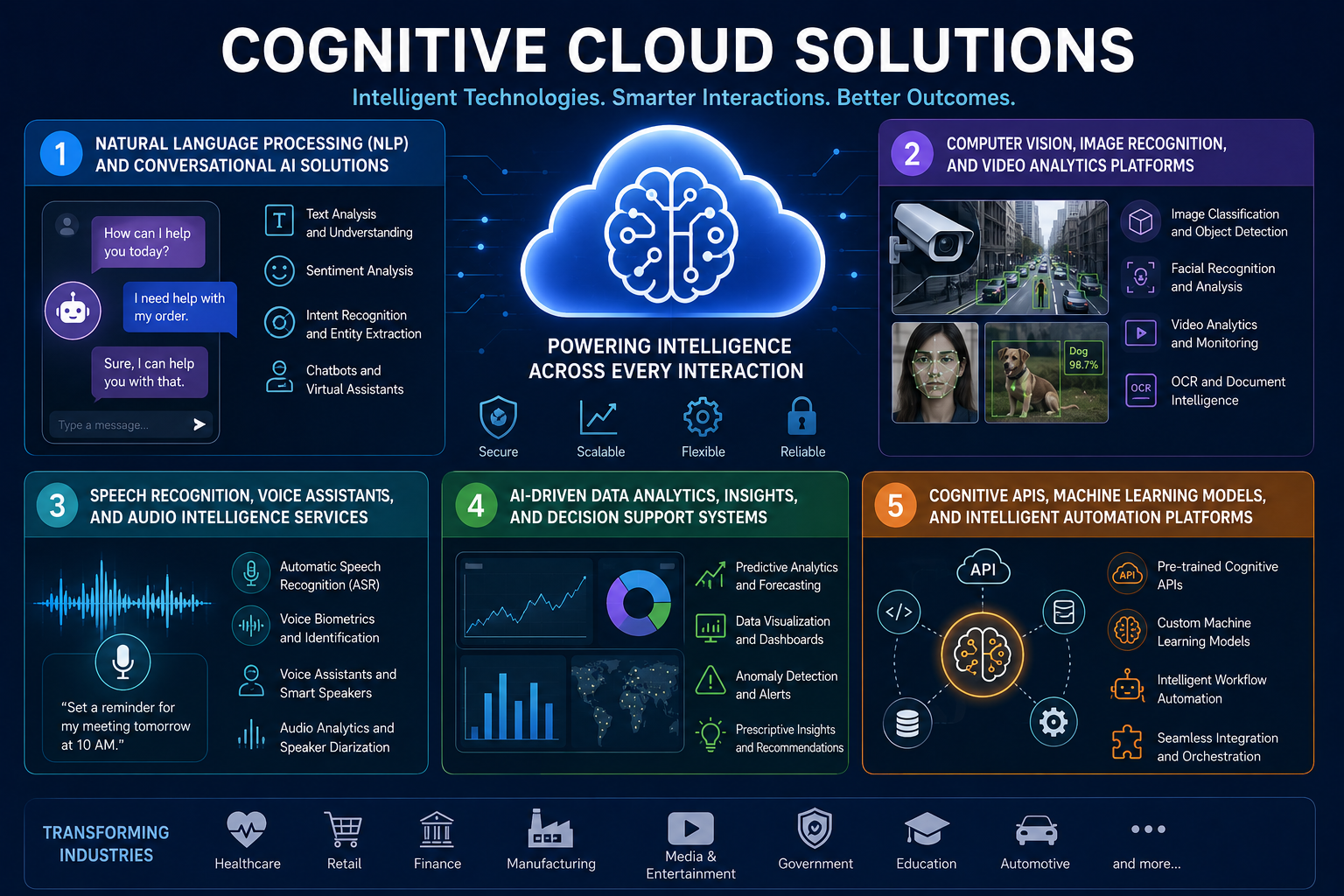
Building a complete cognitive services framework requires a strategic approach that integrates NLP, vision, speech, analytics, and APIs. Natural Language Processing (NLP) and Conversational AI Solutions provide the foundation for understanding and interacting with human language, enabling natural, intuitive user experiences. These capabilities are essential for automating customer interactions, extracting insights from text, and creating engaging applications.
The building blocks of cognitive systems are provided by Cognitive APIs, Machine Learning Models, and Intelligent Automation Platforms, which enable organizations to access and deploy cognitive capabilities. The combination of comprehensive cognitive services and accessible building blocks creates a complete cognitive services framework that drives digital transformation.
Understanding the Cognitive Services Framework
A complete cognitive services framework encompasses all the capabilities needed to build and deploy cognitive applications. This includes NLP, which understands language; computer vision, which interprets images; speech recognition, which processes audio; analytics, which generates insights; and cognitive APIs, which provide access to capabilities.
The framework must be integrated, with components working together seamlessly. NLP must understand language, vision must interpret images, speech must process audio, and analytics must generate insights. The framework must also be accessible, with APIs that enable developers to build cognitive applications. The Cognitive Services Platform Market is projected to grow at a 14.53% CAGR from 2025 to 2035, driven by advancements in AI and increased automation.
The Role of NLP, Vision, and Speech
Natural Language Processing (NLP) and Conversational AI Solutions provide the language understanding for the cognitive services framework. NLP enables systems to understand, interpret, and generate human language. Computer Vision, Image Recognition, and Video Analytics Platforms provide the visual understanding. Speech Recognition, Voice Assistants, and Audio Intelligence Services provide the audio understanding.
Together, these capabilities enable systems to understand and interact with the world in human-like ways. They are essential for applications such as chatbots, virtual assistants, image analysis, and voice-controlled systems.
The Role of Analytics and APIs
AI-Driven Data Analytics, Insights, and Decision Support Systems provide the analytical capabilities for the cognitive services framework. Analytics enables organizations to analyze data and generate insights. Cognitive APIs, Machine Learning Models, and Intelligent Automation Platforms provide the building blocks for cognitive applications.
Together, these capabilities enable organizations to build intelligent, data-driven applications. APIs provide access to cognitive capabilities, while analytics provides insights that inform decision-making and automation. The growing emphasis on ethical AI practices is shaping the development of cognitive services.
Benefits of a Complete Cognitive Services Framework
Organizations that build complete cognitive services frameworks with Natural Language Processing (NLP) and Conversational AI Solutions and Cognitive APIs, Machine Learning Models, and Intelligent Automation Platforms achieve significant benefits. First, they achieve comprehensive cognitive capabilities that understand language, vision, and speech. Second, they achieve accessible capabilities through APIs that enable development.
Third, organizations achieve data-driven insights through analytics that inform decision-making. Fourth, they achieve automation through intelligent automation that streamlines operations. Fifth, organizations achieve innovation through cognitive capabilities that enable new products and services.
Building the Cognitive Services Framework
Building a complete cognitive services framework requires careful planning and execution. Organizations should start with a clear strategy that defines objectives, priorities, and success metrics. This strategy should align with business requirements and consider cognitive, analytics, and API needs.
A phased approach is recommended, starting with foundational capabilities such as NLP or vision, and expanding based on priorities. This includes adding speech, analytics, and APIs. Additionally, organizations should invest in governance practices such as policies, procedures, and monitoring.
Implementation Considerations
Implementing Natural Language Processing (NLP) and Conversational AI Solutions with Cognitive APIs, Machine Learning Models, and Intelligent Automation Platforms requires addressing several considerations. Organizations must assess their cognitive requirements, including use cases, data needs, and integration requirements. They must also evaluate their team's skills and experience.
Technology selection is critical, with choices including cognitive platforms, API services, and analytics tools. Organizations should consider their existing infrastructure and data sources. Additionally, organizations must develop comprehensive governance practices, provide training for staff, and maintain documentation of capabilities.
Future of Cognitive Services Frameworks
The future of cognitive services frameworks is shaped by several emerging trends. The adoption of generative AI is enabling more sophisticated content creation and analysis. The emergence of low-code platforms is democratizing access to cognitive capabilities. The development of specialized AI models is providing more accurate and efficient capabilities. The integration of cognitive services with business applications is becoming more seamless. Additionally, the evolution of AI models is providing more powerful and accessible cognitive services. Organizations that invest in complete cognitive services frameworks will be well-positioned to build intelligent, automated applications. Cognitive APIs, Machine Learning Models, and Intelligent Automation Platforms enables organizations to access and deploy cognitive capabilities, realizing the full potential of cognitive computing.
 Russian
 English
 Arabic
 French
 Spanish
 Portuguese
 Deutsch
 Turkish
 Dutch
 Italiano
 Romaian
 Portuguese (Brazil)
 Greek
